
Nicotine in Hookah: Exposure, Heat, and Filtration Limits
Tobacco shisha contains nicotine, and the water in a hookah does not filter it out. What the CDC and peer-reviewed studies report on exposure per session, and how heat and device design relate to it.
Last updated: October 31, 2026 · Written by Kaloud Editorial Team · Technical review by Reza Bavar, Founder and Lead Designer, Kaloud
Tobacco shisha contains nicotine, and hookah smoke carries it. The CDC reports that one hookah session can expose a person to about 1.7 times the nicotine and nearly 9 times the carbon monoxide of a single cigarette [1]. The CDC also states that the water in a hookah does not filter smoke [1]. Research links exposure to how much smoke is inhaled, for how long, and to heat and device design [2][4].
- One hookah session: about 1.7 times the nicotine of one cigarette [1].
- One hookah session: nearly 9 times the carbon monoxide of one cigarette [1].
- Smoke inhaled in a typical one-hour session: about 90,000 ml, 100 to 200 times one cigarette [1].
- The water in a hookah does not filter smoke [1].
- Peak blood nicotine after a 45-minute waterpipe session matched that after one cigarette in a 31-person lab study [3].

What is in hookah smoke?
Hookah smoke carries compounds from the heated shisha and from the burning charcoal. The CDC lists three groups:
- Nicotine. It comes from the tobacco leaf. The CDC calls it the same highly addictive chemical found in other tobacco products [1].
- Carbon monoxide, metals and cancer-causing chemicals. The charcoal used to heat the tobacco can produce high levels of all three [1].
- Other toxic agents. The smoke still has high levels of toxic agents after it passes through the water [1].
For how nicotine is absorbed and what it does in the body, see Does Hookah Have Nicotine? Absorption, Effects, and Exposure.
How much nicotine exposure comes from one session?
Studies measure exposure per session, and a session delivers more smoke than a cigarette. Session length and smoke volume drive the totals.
| Measure | Finding | Source |
|---|---|---|
| Nicotine per session | About 1.7 times one cigarette | CDC [1] |
| Carbon monoxide per session | Nearly 9 times one cigarette | CDC [1] |
| Smoke inhaled, pooled studies | 74.1 liters per session against 0.6 liters per cigarette | Primack et al., 2016 [2] |
| Peak blood nicotine | 10.2 ng/mL after waterpipe, 10.6 ng/mL after one cigarette | Eissenberg and Shihadeh, 2009 [3] |
| Peak carboxyhemoglobin | 3.9% after waterpipe, three times the 1.3% after one cigarette | Eissenberg and Shihadeh, 2009 [3] |
The 2016 meta-analysis also found higher nicotine, tar and carbon monoxide per waterpipe session than per cigarette [2]. A 2007 review concluded that daily waterpipe use produces nicotine absorption of a magnitude similar to daily cigarette use [4].
Does the water in a hookah filter nicotine?
No. The CDC states that the water in a hookah does not filter smoke, and that the smoke still has high levels of toxic agents after it passes through the water [1].

Water cools the smoke on its way to the hose. A cooler or smoother draw is a change in temperature and feel. The sources above give no basis for reading it as lower nicotine or carbon monoxide exposure.
How do heat and device design relate to exposure?
Published estimates of nicotine exposure vary with burn temperature, tobacco type and waterpipe design [4]. Heat is one input among several. The per-session totals above reflect a long session and a large volume of smoke [1][2].
Charcoal is the heat source in a traditional hookah. The CDC notes it can produce high levels of carbon monoxide, metals and cancer-causing chemicals [1]. Any device that holds the charcoal still burns it.
Heat also changes the shisha itself. Controlled studies of heated glycerol and propylene glycol detected breakdown products from about 215°C [5]. Those studies tested the solvents, not hookah smoke. For what overheating does to shisha, see What Happens to Shisha Molasses When It Overheats?
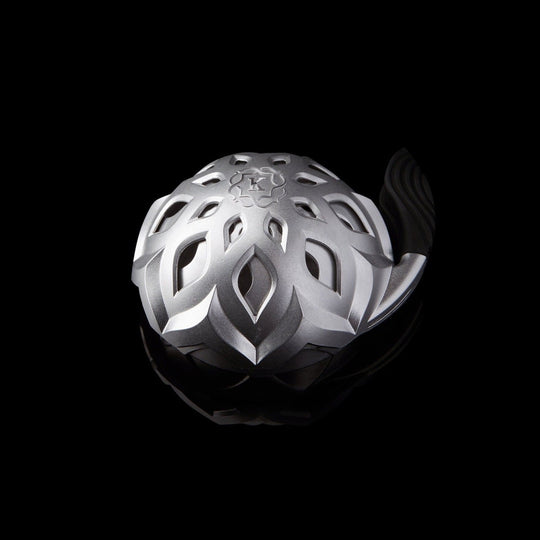
A heat management device such as the Kaloud Lotus sets how charcoal heat reaches the bowl, and Kaloud targets 130 to 220°C at the shisha [6]. That figure is a bowl temperature. It is not a measure of nicotine or carbon monoxide. For the full temperature data, see What Temperature Should Shisha Be Heated To?
Does herbal shisha contain nicotine?
Shisha made without tobacco is sold as nicotine-free. The charcoal and the smoke remain. The CDC reports that smoke from both tobacco-based and herbal shisha contains carbon monoxide and other toxic agents [1].
Frequently asked questions
Does hookah smoke contain nicotine?
Yes, when the shisha contains tobacco. The CDC reports that one hookah session can expose a person to about 1.7 times the nicotine of a single cigarette.
Does the water in a hookah filter out nicotine?
No. The CDC states that the water in a hookah does not filter smoke, and the smoke still has high levels of toxic agents after passing through it.
Does heat change nicotine exposure?
A 2007 review found that nicotine exposure estimates vary with burn temperature, tobacco type and waterpipe design. The CDC and meta-analysis figures reflect long sessions and large smoke volumes.
Does a heat management device reduce nicotine exposure?
Kaloud makes no such claim. A heat management device controls bowl temperature. The charcoal still burns, and Kaloud's readings measure temperature, not smoke content.
How does one hookah session compare with one cigarette?
The CDC reports about 90,000 ml of smoke in a typical one-hour session, 100 to 200 times one cigarette, with nearly 9 times the carbon monoxide and 1.7 times the nicotine.
References
- Centers for Disease Control and Prevention, "Hookahs." Smoking and Tobacco Use, last reviewed October 17, 2024. cdc.gov
- Primack, B. A., et al. "Systematic Review and Meta-Analysis of Inhaled Toxicants from Waterpipe and Cigarette Smoking." Public Health Reports 131, no. 1, 2016: 76 to 85. pubmed.ncbi.nlm.nih.gov
- Eissenberg, T., and Shihadeh, A. "Waterpipe Tobacco and Cigarette Smoking: Direct Comparison of Toxicant Exposure." American Journal of Preventive Medicine 37, no. 6, 2009: 518 to 523. pubmed.ncbi.nlm.nih.gov
- Neergaard, J., et al. "Waterpipe Smoking and Nicotine Exposure: A Review of the Current Evidence." Nicotine and Tobacco Research 9, no. 10, 2007: 987 to 994. pubmed.ncbi.nlm.nih.gov
- "A Device-Independent Evaluation of Carbonyl Emissions from Heated Electronic Cigarette Solvents." PLOS One, 2017. journals.plos.org
- Kaloud in-house temperature testing, Lotus I+3, tall black bowl, 30 g, LOG200-TC logger with Type K thermocouples. Sessions of 13, 20 and 23 September 2026.
About the reviewer: Reza Bavar is the founder and lead designer of Kaloud. He designed the Kaloud Lotus heat management device and continues to design and develop Kaloud hardware, from heat management and bowls to complete hookah systems.